
Lab vs commercial EIS (part 1): Why scale changes everything
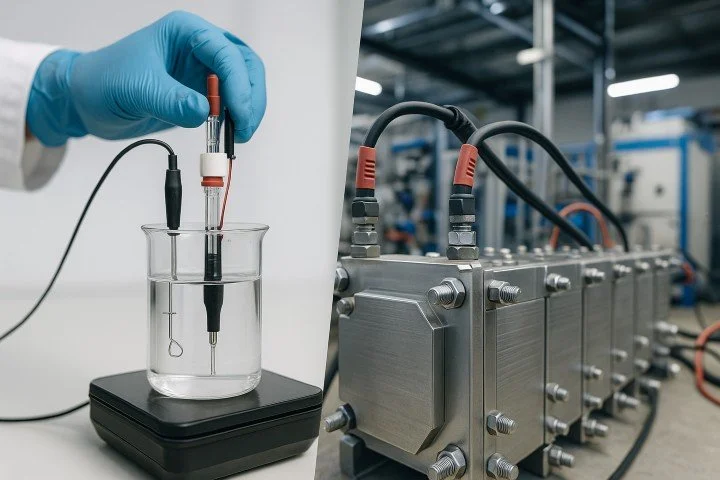
Every electrolyser manufacturer faces the same challenge: what works brilliantly in the lab often behaves very differently at commercial scale. This is especially true for Electrochemical Impedance Spectroscopy (EIS) – a diagnostic technique that's invaluable for understanding electrolyser performance, but looks radically different when you're measuring a 500 kW stack versus a coin-sized catalyst sample.
If you're evaluating EIS data from research partners or considering implementing it in your operations, understanding these differences is essential for making informed decisions about stack health monitoring and maintenance strategies.
Why this matters: Two different worlds
In research labs, EIS is the gold standard for probing the electrochemical processes and interfaces inside an electrolyser with exceptional frequency resolution. Researchers use it to characterise the hydrogen evolution reaction (HER):
2H⁺ + 2e⁻ → H₂
and the oxygen evolution reaction (OER):
2H₂O → O₂ + 4H⁺ + 4e⁻
These measurements reveal critical performance parameters: charge transfer resistances at catalyst-electrode interfaces, mass transport limitations in porous layers, and ohmic losses through membranes and current collectors.
This level of detail allows researchers to identify which specific process limits performance—whether it's sluggish reaction kinetics, insufficient catalyst surface area or poor ionic conductivity—and optimise accordingly.
But commercial operators live in a different world. For them, every hour of downtime equals lost revenue. A commercial electrolyser stack – with its dozens or hundreds of cells, operating at hundreds of amps and voltages exceeding 100 volts – can't simply be shut down for detailed characterisation. Some systems even run on fluctuating renewable power sources (like Endua's field-deployed systems), adding another layer of complexity with transient operating conditions.
The assurance? EIS that can monitor stack health in real-time, detect early-stage membrane degradation or catalyst poisoning, and enable truly predictive maintenance.
The catch? Getting there requires completely different approaches to measurement and data interpretation.
Size does matter (a lot)
The scale gap creates fundamental differences in what you're actually measuring:
Lab-scale catalyst testing examines active areas as small as 0.1 cm² with currents measured in milliamps (10-100 mA). At this scale, you can use three-electrode configurations with a reference electrode, allowing you to isolate anode and cathode contributions independently. It's like testing a single tile to understand a roof – you get exceptional detail about material properties.
Lab-scale flow electrolysers step up to 5-25 cm² active areas with currents up to 50 A, typically testing one to three cells in short stack configurations. Here you begin to see cell-to-cell variations and stack-level transport phenomena, though measurements remain intermittent.
Commercial stacks operate with 50-500 cm² cells at 500+ A across full multi-cell stacks. Now you're measuring a spatially-averaged response from the entire system – current distribution non-uniformities, temperature gradients and individual cell variations all contribute to the impedance spectrum. The two-electrode configuration (working and counter only) sacrifices the ability to deconvolute individual electrode contributions, but enables continuous, online monitoring without production interruption.
This isn't just a quantitative difference – the physics changes. At commercial scale, distributed resistances and capacitances along current collectors become significant, inductive effects from high-current bus bars can appear at high frequencies, and thermal management becomes a measurable electrochemical variable.
Coming next: A detailed comparison of EIS capabilities across all three scales, and what you gain (and lose) at each level.