
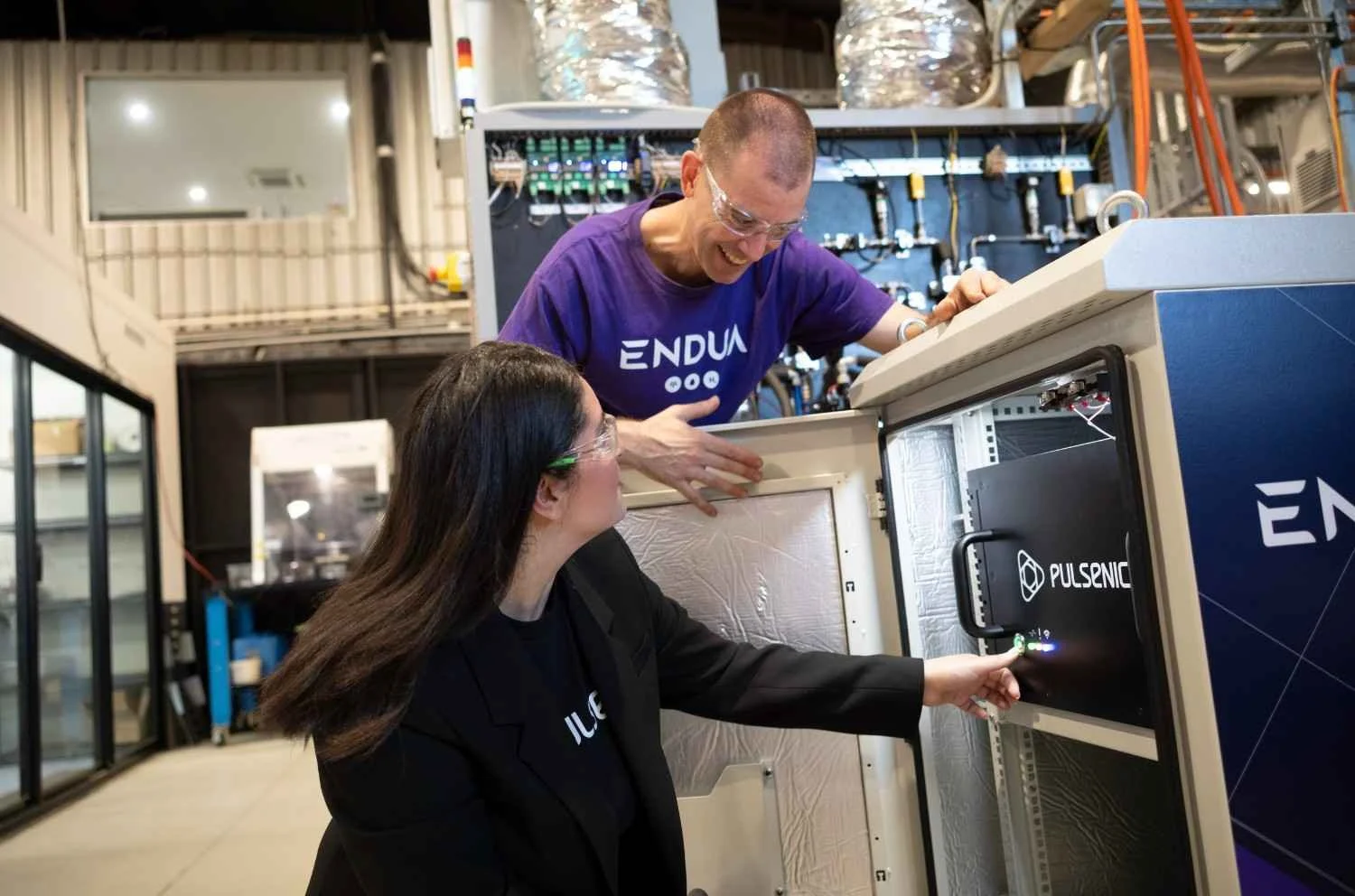
- PEM electrolysers produce high-purity hydrogen on-site, reducing the need for transport and bulk storage at Indian factories.
- Grid-connected systems can draw power from renewable sources, open-access solar, or the local electricity grid, depending on site conditions.
- India's National Green Hydrogen Mission and SIGHT programme create policy incentives that improve the business case for on-site hydrogen.
- PEM electrolysers, such as Endua's pre-engineered, factory-tested PEM electrolysers, are suitable for rapid deployment and can operate across a 30–100% turndown range.
- Selecting the right electrolyser depends on water quality, power supply stability, hydrogen purity requirements and site-specific environmental conditions.
Industrial operators across India face a specific challenge: decarbonising factory-floor processes while keeping production stable and commercially viable. Electrification covers a large share of low-temperature applications, but it can't address every energy demand, particularly high-grade heat, heavy transport across industrial parks, and operations in regions where grid capacity is constrained. In these cases, on-site hydrogen production can help meet the remaining energy demand.
In this article, we discuss how grid-connected PEM electrolysers work in Indian industrial settings, which factors shape deployment and how to assess their suitability for your facility.
What is a PEM electrolyser and how does it work?
A proton exchange membrane (PEM) electrolyser splits purified water into hydrogen and oxygen using an electric current passed through a solid polymer membrane. The membrane allows protons to move from the anode to the cathode, where they combine with electrons to form hydrogen gas.
PEM systems produce hydrogen at higher pressure and higher purity than many conventional alkaline electrolysers, often delivering output at 30 bar or above with purity levels around 99.999% or higher. This can reduce the need for additional compression and purification equipment downstream.
For Indian factories that need hydrogen as an industrial feedstock (for example, in glass manufacturing, electronics or metal heat treatment), this high-purity output is operationally important. Lower-purity hydrogen can shorten equipment lifespans and affect product quality.
Why grid compatibility matters for Indian manufacturing
India's electricity grid varies significantly by state and region. Power quality and reliability vary by state, distribution utility, industrial feeder and site, so operators should assess local supply data rather than rely on state-level assumptions.
A grid-connected PEM electrolyser can adjust its hydrogen output to match available power. PEM systems generally offer faster dynamic response than alkaline systems, making them better suited to rapidly varying power, although actual response times depend on the equipment and operating conditions. With appropriate controls and operation, a PEM electrolyser can follow variable solar, wind or grid power while managing stack-cycling risks.
This can make a difference if you plan to use India's growing open-access renewable energy market, where power availability can vary throughout the day.
How India's policy framework supports factory-level hydrogen
India's National Green Hydrogen Mission (NGHM), launched in January 2023, targets 5 million tonnes per annum of green hydrogen production by 2030. The Strategic Interventions for Green Hydrogen Transition (SIGHT) programme offers capital incentives for both electrolyser manufacturing and green hydrogen production.
According to a recent SBICAPS report, SIGHT auctions suggest growing industry interest in green ammonia and increasingly competitive pricing. Together with government incentives, this policy support is helping strengthen the business case for green hydrogen and green ammonia production in India.
Depending on project eligibility and commissioning date, you may receive support such as a 100% Inter-State Transmission System (ISTS) charge waiver for eligible green-hydrogen or green-ammonia projects commissioned by 31 December 2030, for 25 years from commissioning, along with applicable central and state incentives. Be sure to check foreign direct investment relaxations, and electricity and land incentives for your relevant state and project structure.
What factory operators should assess before deploying a PEM electrolyser
There are five factors that can shape whether on-site hydrogen production is viable and cost-effective for your operation.
1. Water quality and treatment requirements
PEM electrolysers require treated water meeting manufacturer specifications – stacks require very high-purity deionised water, while complete systems may include upstream treatment. Indian factory sites drawing from bore wells or municipal supply will typically need a water treatment system upstream of the electrolyser. This may affect your site preparation requirements and operating costs.
2. Power supply and grid connection
Assess your available power: dedicated renewable source, captive solar, grid connection, or a hybrid of these. PEM electrolysers with a 30–100% turndown range can follow variable renewable output. A clear view of your daily and seasonal power profile will help you size the system accurately.
3. Hydrogen demand and storage
Map your actual hydrogen consumption in kilograms per day. Producing hydrogen on-site can remove transport costs, although your project may still require buffer storage when production and consumption do not align. On-site production may reduce required storage volumes where production is closely matched to demand (but results can depend on your operating profile and required supply resilience).
4. Site conditions and safety compliance
Temperature, humidity, dust, and available footprint all influence system design and enclosure requirements. Indian industrial sites can face ambient temperatures above 45°C during summer months, which affects cooling requirements for the electrolyser stack and balance of plant.
5. Regulatory and safety standards
India's Petroleum and Explosives Safety Organisation (PESO) oversees hydrogen storage and handling regulations. Hydrogen installations may require hazardous-area classification and equipment compliant with applicable IS/IEC 60079 requirements. The classification can be established through a site-specific engineering assessment. A clear compliance pathway can help you assess the project before committing capital.
How PEM compares with alkaline electrolysers for Indian conditions
Both PEM and alkaline electrolysers are commercially available technologies, according to the International Energy Agency. Choosing between them depends on your operational context. For a detailed comparison, see our guide on PEM vs alkaline vs AEM electrolyser technology.
| Factor | PEM electrolyser | Alkaline electrolyser |
|---|---|---|
| Response to load changes | Seconds | Minutes |
| Output pressure | Typically around 30 bar or higher | Typically around 1–15 bar |
| Hydrogen purity | Typically 99.97%+ | 99.5% |
| Turndown range | Typically 30–100% | Typically 60–100% |
| Footprint | Compact, containerised options available | Larger physical footprint |
| Suitability for variable renewables | High (fast ramp-up/down) | Low (slower response) |
For Indian factories with variable renewable power inputs or limited site footprint, PEM technology's compact design and fast dynamic response can be a more practical fit. If your factory needs steady hydrogen production and cost per kilowatt is the main consideration, an alkaline system may also be suitable.
Why on-site production changes the cost equation in India
Hydrogen transport infrastructure is still developing in India, so availability and delivered cost can vary substantially by region and project scale. Moving compressed hydrogen by tube trailer is expensive, and delivery logistics add cost, risk and scheduling complexity. Because compressed hydrogen has relatively low volumetric energy density compared with liquid fuels, transport can become less attractive for small or dispersed demand centres, depending on distance and delivery configuration.
When hydrogen is produced at the point of use, transport costs disappear. Storage requirements may also shrink as you align production with daily demand rather than holding buffer inventory for unpredictable deliveries. Learn more about why on-site hydrogen generation changes the economics. Endua's on-site, on-demand hydrogen systems can reduce transport and storage requirements while giving you more control over supply.
For a factory in an Indian industrial corridor, the operational environment may be the deciding factor. Assess your diesel use, power costs, grid constraints and hydrogen consumption profile. These factors can impact whether on-site production is commercially viable for your site.
What role does Endua's PEM technology play in India's hydrogen adoption?
Endua builds pre-engineered, factory-tested PEM electrolysers in Queensland, Australia, backed by over 19 years of PEM electrolysis research and development with CSIRO and more than 30,000 hours of stack test data. Endua's industrial-scale systems produce high-purity hydrogen at 35 bar native output pressure, with a 30–100% turndown range that tracks variable renewable energy output.
If you're assessing on-site hydrogen production in India, Endua's containerised modular system can reduce the site work involved in delivery, installation and commissioning. This approach can reduce deployment to months, compared with the 1 to 3 years typical of traditional engineering, procurement and construction (EPC) projects.
Endua also provides installation support, monitoring and maintenance, making it easier to integrate a new hydrogen system into your existing plant. Our approach to building the business case for on-site hydrogen applies directly to factory-scale projects in India.
Getting started: A practical framework for Indian factory operators
If you're evaluating on-site hydrogen for your factory, start with these steps:
Map your energy use. Identify high-cost, high-emission, or reliability-sensitive applications where hydrogen can displace diesel, imported gas or grid-dependent electric heating.
Quantify your hydrogen demand. Calculate consumption in kilograms per day for each application. This determines electrolyser sizing and storage requirements.
Assess your power supply. Document your renewable generation capacity, grid connection reliability and open-access power purchase options. PEM electrolysers perform well with variable inputs, and accurate site data helps you size the system correctly.
Review site conditions. Dust, temperature extremes, available footprint, water quality and proximity to hazardous areas all influence system design.
Confirm your compliance pathway. Engage with PESO requirements and state-level hydrogen policies early. Clarifying the requirements early can reduce project risk and avoid delays.
Evaluating PEM electrolysers for your Indian factory
PEM electrolysers can support on-site green hydrogen production for hard-to-abate industrial processes and reduce reliance on imported fuels. India's growing policy support may also strengthen the business case. Consider making a decision based on your site's specific conditions: power availability, hydrogen demand profile, water quality, and regulatory requirements.
Endua works with industrial operators on on-site hydrogen systems that can reduce energy costs, strengthen resilience and support decarbonisation goals. Get in touch with our technical team to discuss your site requirements and assess whether on-site PEM electrolysis is viable for your operation.
FAQs about PEM electrolysers for industrial hydrogen production in India
What is a grid-connected PEM electrolyser?
A grid-connected PEM electrolyser connects to the local electricity grid or renewable energy source and adjusts hydrogen output based on available power. PEM technology responds to load changes in seconds, making it well-suited for pairing with variable solar or wind inputs common in Indian industrial settings.
How much hydrogen can a factory-scale PEM electrolyser produce?
Production capacity depends on the electrolyser's rated power. A 1 MW PEM electrolyser can produce approximately 400 to 450 kilograms of hydrogen per day. Endua's modular architecture scales from single-unit systems to multi-stack configurations, matching output to your specific consumption needs.
Is on-site hydrogen production cost-effective for Indian factories?
On-site production can remove hydrogen transport costs and reduce bulk storage requirements, both of which may account for a significant share of the total delivered cost in India. Combined with SIGHT programme incentives, eligible ISTS benefits and declining renewable energy prices, the business case is improving for factories with steady hydrogen demand.
What safety standards apply to hydrogen production in Indian factories?
Hydrogen installations may require PESO approvals and must also comply with applicable electrical, fire, pressure-equipment, environmental and state requirements. Projects should assess hazardous-area classification and applicable IS/IEC 60079 requirements, and undertake appropriate HAZID, HAZOP and other risk assessments required by the project’s approvals and safety case.
Can PEM electrolysers run on solar power in India?
PEM electrolysers are generally well suited to solar-powered operation because of their fast load-following capability and wide turndown range (30–100%). An Indian factory with captive or open-access solar can produce green hydrogen during peak generation hours and store it for use across operating shifts.